at the
Juneau Raptor Center
revised February, 2009
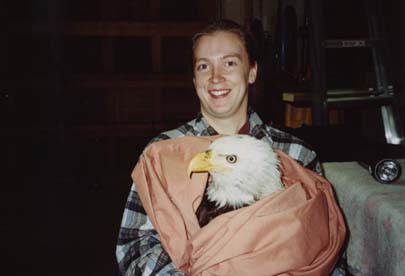
Trapper, adult bald eagle
Trapper, adult bald eagle
When I was in college my mother joined the Juneau Raptor Center
(JRC) and I slowly began to accompany her as she cared for injured
birds, eventually becoming a volunteer myself. The Raptor Center
is a non-profit organization
dedicated to the rehabilitation and release of raptors and other wild
birds and to the education
of the public. Only a handful of interested volunteers run the
organization
and care for all the birds. Though birds of prey are the focus of
the center,
native birds of all kinds are cared for from tiny warblers to great
blue
herons. Both my parents are members now, my father on the
construction and board end of things and my mother more on
the bird care end of things.
I composed this page in the early years of my
volunteering (around 2003) and haven't updated it much since.
Consequently, the stories below are some of the earliest from my
experience at JRC. I'd like to add more as time and energy allow
about the birds I've helped train (Patch the great-horned owl and
Monalisa the red-tailed hawk), and some of the other birds that stood
out over the years. Because of the number of mews around our
houses (see below), my mother often winds up taking care of quite a few
birds on her own and I try to assist her as much as I can (which is not
nearly enough). Today my main charge is Monalisa, "my" ed bird,
who lives in my garage.
Education birds
When raptors come in that heal but are considered non-releasable
(permanently broken wings, loss of eyes, loss of talons, etc.), a few
likely candidates are kept as education birds
to spend the rest of their lives in captivity to assist in educating
the public, occasionally appearing at schools and public
functions. US Fish and Wildlife issues the permits for
non-releasable raptors and requires that most partake in at least
twelve programs annually. As of this update, the Raptor Center
has two bald eagles (Justice is fist-trained for programs and Lady
Baltimore (aka Spirit) spends the summers at the top of the tram on Mt.
Roberts), a northern harrier (marsh)
hawk named AJ who was electrocuted and lost two talons on each foot;
Blueberry, an imprinted raven; Phil, a gyrfalcon from the Kuskokwim who
can't grow flight feathers; Brutus, a red-tailed hawk missing an eye;
and Monalisa, a dark (Harlan's) red-tailed hawk with a broken elbow.
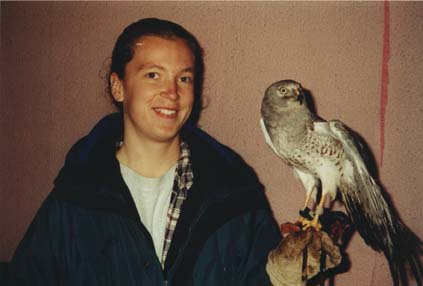
Kira, peregrine falcon
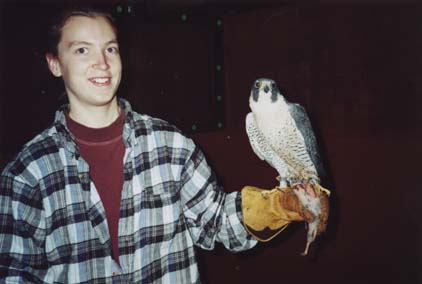 Tundra swan (the first rescue)
My
first experience in JRC was assisting my parents on a rescue mission to
capture a tundra swan that was unable to fly. In December of
2000, a woman
looking out over Gastineau Channel from her house noticed a flock of
migratory
swans, not an uncommon sight during migration. As the
swans flew away, one individual was left behind, flapping but
apparently unable to get off the water. Its right wing seemed
broken and she called the Raptor Center. A
few days later on a bitter cold afternoon, my parents and I left Aurora
Harbor in their river boat and scanned the surrounding shores for
something
white; as there was little snow on the ground the swan was not hard to
find sitting on the beach grass of Douglas Island. What followed
was a frustrating chase; the swan stayed on land when the boat
approached
the beach and escaped back into water when we tried to catch her on
shore.
Finally, my parents dropped me off on the beach to keep the swan in the
water while they pursued her by boat. The exhausted bird was soon
captured in a net and transferred to a large kennel in their warm
garage.
She frightened us by drooping her long neck while we held her.
Within minutes of being left alone, however, she held it up gracefully
and seemed to generally improve. A trip to the vet revealed that
she had been shot (illegally) and two pellets were lodged near the
wrist
of her right wing. The vet was able to remove one pellet and
clean
the wound, but the other was left intact lest removing it do more
damage by digging
around the base of her feathers. The swan was held for
recuperation
at the the King residence on Sunny Point; she remained indoors for a
few weeks before they let
her into a fenced enclosure with a pond. We debated whether to
keep
her in captivity until the spring migration brought the other tundra
swans
heading north again or whether to let her go as soon as she was able
fly.
Perhaps it is just as well that we never had to make the decision--the
swam apparently gained the ability to fly again several days after
being
let outside and disappeared from her enclosure. We hope she met
up
with her mate and family somewhere far to the south.

Super
My parents picked up Super on the bike path near the Mendenhall
Mall in late winter, 2001. She was a poor, starving, immature
bald eagle not even a year old with huge blistery sores the size of
large
marbles on her face and feet, a truly sorry sight. She had avian
pox, the bird equivalent of small pox, and would need
to be kept in captivity six months before it would be safe to release
her.
Though she gained strength over weeks of feedings her sores only slowly
improved and there was some talk of euthanizing her lest she spread the
disease to other birds--(there is still debate about whether this is
possible
once a bird has recovered). My parents fought for her until she
came
to live in an 8' by 8' mew across from my front door. One of the
boats I worked on that summer stopped at the Gustavus dock several
times
a week where sport fishing boats cleaned their catches;
while the rest of my crew bartered for extra halibut and crab I grabbed
salmon heads, (a bald eagle delicacy), and roe and brought them home
for
Super. She ate like a horse and recovered strength over the
course
of the summer and the small sores around her mouth and feet slowly
diminished.
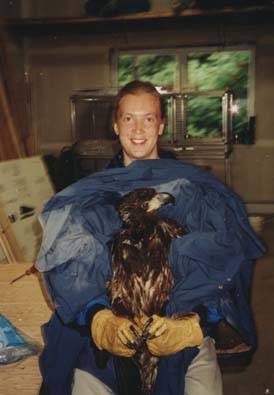
Super, immature bald eagle
 By
fall, however, Super still had a disturbingly large sore in front of
her
left eye which prevented her from seeing forward. She also became
increasingly agitated with human company and frustrated with the
confinement
of the mew. We had a large mew, (10' by 20' by 13' tall), where
AJ
lived for about a month before he moved to another house. When he
left, Super moved in and was much more comfortable in a home better
suited
to her size and where she could fly from one end to the other.
The
sore no longer troubled her vision, but we kept her in captivity for
the
cold winter months while food was scarce and daylight scarcer.
When the eulachon and the herring start running
in May (2002) we released Super only a few days from her one year
anniversary in
captivity. My mother set her down on the beach at Outer Point and we
watched
as she flew a few feet above the ground to land on a stump in the
distance.
Unwilling to leave it at that, we stayed around for a few minutes
hoping
that she would perch in a less vulnerable place. After fifteen minutes
on her stump, she lifted straight into the air about thirty feet and
flew
down the beach beautifully right over all of our heads and landed in a
hemlock tree. She was still sitting there when we left.
By
fall, however, Super still had a disturbingly large sore in front of
her
left eye which prevented her from seeing forward. She also became
increasingly agitated with human company and frustrated with the
confinement
of the mew. We had a large mew, (10' by 20' by 13' tall), where
AJ
lived for about a month before he moved to another house. When he
left, Super moved in and was much more comfortable in a home better
suited
to her size and where she could fly from one end to the other.
The
sore no longer troubled her vision, but we kept her in captivity for
the
cold winter months while food was scarce and daylight scarcer.
When the eulachon and the herring start running
in May (2002) we released Super only a few days from her one year
anniversary in
captivity. My mother set her down on the beach at Outer Point and we
watched
as she flew a few feet above the ground to land on a stump in the
distance.
Unwilling to leave it at that, we stayed around for a few minutes
hoping
that she would perch in a less vulnerable place. After fifteen minutes
on her stump, she lifted straight into the air about thirty feet and
flew
down the beach beautifully right over all of our heads and landed in a
hemlock tree. She was still sitting there when we left.
Lucky
Super's mew was next occupied by an immature
bald eagle named Lucky (or, by some, Cessna). Originally brought
to the Center in her first year, Lucky was hit by a
car and quickly recovered. Then, In the summer of 2002, a
grounded eagle was reported
near the Juneau Airport and was caught after living on the ground for
as
long as several weeks. The band on her leg allowed us to identify
her as the same same eagle from four years before; now she was in
transition
from immature to adult coloration with a dirty white head and tail, a
few
white speckles on the back of her neck, a beak that was half yellow and
half gray and one yellow and one brown eye! It was something else
to
have her gaze at you with those eyes. This time Lucky apparently
had the tip of her wing sheared off by an airplane propeller (hence the
name Cessna). Though she can fly about 20 feet horizontally
she'll
never be able to hunt again in the wild. Lucky was eventually
sent to an education facility down south.
Thud
Thud was a fierce looking
western screech owl who might have been intimidating but for her short
stature. Standing six inches tall )plus an inch of ears) Thud was
quite charming and rather large for a western screech owl. Flying
near Thane Road at night not far from the ruins of the AJ mine she had
the misfortune to collide with the front of the Juneau Recovery van,
making
a sound which the driver suggested as her name. Trained in first
aid, the driver promptly picked up the stunned bird, wrapped her in
blanket
and put an oxygen mask over her face and
called the Raptor Center. My parents picked her up and placed her
in a kennel at another volunteer's garage (the closest thing we have to
a clinic),
where she laid in a stupor. Hope for her survival was slim as she
laid motionless on her side, but within a few days she was
standing.
While she had no bone damage, a few members believed she might have
brain
damage as she refused to perch and some believed she leaned to one
side.
Once a week, my mother and I took turns picking her up while the other
opened her beak and placed small pieces of mice inside, which Thud then
readily swallowed.
 Over
many weeks, she slowly ate larger and larger pieces and eventually took
to eating dead mice left in her kennel. By this time, she'd
become
quite feisty and escaped from her kennel twice while volunteers tried
to
collect her, proving that she still had the ability to fly and perch by
leading them on a merry chase through the garage. Clearly Thud
was
ready to go, but the Center hesitated until it was proven that she
could
catch live food on her own. One Friday my mother and I scoured
the
town for small rodents and eventually came up with some young gerbils
from
Swampy Acres; we bought two ill-fated individuals and placed one with
Thud
in a small cage specially built by my parents to test her hunting
skills.
As we peered excitedly into the cage (having overcome the first qualms
of willingly placing creatures in mortal danger) Thud sat and stared at
us while the gerbil placidly wandered around her feet and under her
tail.
It was unimpressive hunting to say the least. We left her alone
with a blanket draped over the cage so she could ignore us while we
tended
to other birds; a minute later I heard a scurrying noise and looked
over
to see a terrified gerbil running along the inside edge of the cage
followed
swiftly by a swoosh and Thud's foot. She snatched the gerbil,
carried
it to the center of the cage, ate the head, and then looked up at us
with
an innocent and stoic gaze as we lifted up the blanket to see
her.
A week later, Thud was released at the head of Sheep Creek Trail.
Over
many weeks, she slowly ate larger and larger pieces and eventually took
to eating dead mice left in her kennel. By this time, she'd
become
quite feisty and escaped from her kennel twice while volunteers tried
to
collect her, proving that she still had the ability to fly and perch by
leading them on a merry chase through the garage. Clearly Thud
was
ready to go, but the Center hesitated until it was proven that she
could
catch live food on her own. One Friday my mother and I scoured
the
town for small rodents and eventually came up with some young gerbils
from
Swampy Acres; we bought two ill-fated individuals and placed one with
Thud
in a small cage specially built by my parents to test her hunting
skills.
As we peered excitedly into the cage (having overcome the first qualms
of willingly placing creatures in mortal danger) Thud sat and stared at
us while the gerbil placidly wandered around her feet and under her
tail.
It was unimpressive hunting to say the least. We left her alone
with a blanket draped over the cage so she could ignore us while we
tended
to other birds; a minute later I heard a scurrying noise and looked
over
to see a terrified gerbil running along the inside edge of the cage
followed
swiftly by a swoosh and Thud's foot. She snatched the gerbil,
carried
it to the center of the cage, ate the head, and then looked up at us
with
an innocent and stoic gaze as we lifted up the blanket to see
her.
A week later, Thud was released at the head of Sheep Creek Trail.
Jake
And then there was Jake, a feisty, immature glaucous-winged
gull who was hit by a car while eating french fries. The man
responsible
for the meal threw his coat over the stunned gull and called the Raptor
Center. Jake stayed at my parents' house and was cared for by my
mother and I for several weeks, alternately endearing himself to us and
making us very angry. He was apparently unharmed except for a bad
scrape on his leg and the fact that he refused to eat, a most
unseagull-like
characteristic. Each day we cleaned and rebandaged his wound and
struggled to get him to eat on his own. A few days of fasting
while
being presented with the most appetizing array of foods we could think
of (we even made a few french fries) failed to move him to eat, so we
had to force-feed him. Cubes of halibut was the only thing he
would
keep down for some time! I would never have imagined that the
throat
of a bird could be so huge, expanding to at least twice the size of his
head, (or so it seemed), while he regurgitated a crop full of warm
slimy
fish we'd just spent far too much time getting into him. He was
very
frustrating.
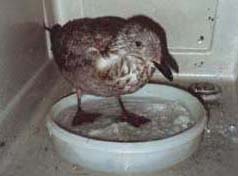
Jake, immature glaucous-winged gull (bathing)
 Over
time, however, Jake began to eat more freely
until we only had to place the corner of a piece of fish onto his
tongue
before he would swallow. Unless we introduced a food other than
fresh
fish, Jake often didn't regurgitate his meal and we grew more adept at
opening his mouth and encouraging him to swallow. We soon
discovered
that Jake's favorite pastime was bathing so we provided him daily with
a big tub of water. Because his bathing efforts were so vigorous,
we removed everything else from his kennel so it wouldn't become
drenched.
When his leg healed sufficiently to release him my mother tried a new
approach to Jake's eating problem. She collected fresh seaweed
from
the beach and added pieces of jack salmon, putting a bowl of the
mixture
in his kennel to encourage him to rummage around as seagulls do and
possibly
eat what he found. Amazingly, it worked. He began to eat
regularly
on his own and so we hastened to release him. On the appointed
day,
we found a large flock of gulls feeding on the flats beneath the bridge
and decided to release him there. When we opened his kennel, Jake
emerged slowly, walked around for a few minutes, stretched his wings by
flying straight up, and then pointed himself toward the water and flew
down to the other gulls. The last thing we saw Jake do before he
blended in with the other gulls was bathe in the channel.
Over
time, however, Jake began to eat more freely
until we only had to place the corner of a piece of fish onto his
tongue
before he would swallow. Unless we introduced a food other than
fresh
fish, Jake often didn't regurgitate his meal and we grew more adept at
opening his mouth and encouraging him to swallow. We soon
discovered
that Jake's favorite pastime was bathing so we provided him daily with
a big tub of water. Because his bathing efforts were so vigorous,
we removed everything else from his kennel so it wouldn't become
drenched.
When his leg healed sufficiently to release him my mother tried a new
approach to Jake's eating problem. She collected fresh seaweed
from
the beach and added pieces of jack salmon, putting a bowl of the
mixture
in his kennel to encourage him to rummage around as seagulls do and
possibly
eat what he found. Amazingly, it worked. He began to eat
regularly
on his own and so we hastened to release him. On the appointed
day,
we found a large flock of gulls feeding on the flats beneath the bridge
and decided to release him there. When we opened his kennel, Jake
emerged slowly, walked around for a few minutes, stretched his wings by
flying straight up, and then pointed himself toward the water and flew
down to the other gulls. The last thing we saw Jake do before he
blended in with the other gulls was bathe in the channel.
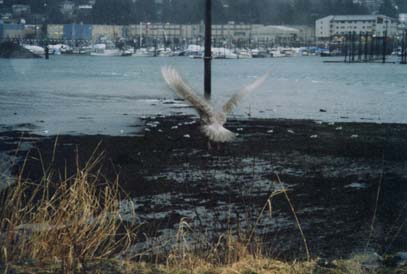
Jake's release