Snettisham Construction Adventure
2003: The Start
Planning
 The winter of 2002-2003
began serious plans for the business and my
life was more hectic and stressful than anything I'd ever like to put
myself through again. I spent every 15
minute break at work, every lunch hour and most of my free time
researching everything I could think of to buy, build, or create. Cabins, floor plans, incorporation/licensing,
land lease, furniture, propane appliances, drinking water systems,
waste water systems, permitting, boats, etc.
By the spring I was running myself to exhaustion trying to put
everything together. I found cabin kits in
British Columbia, hired an engineer to design a lodge, worked with the
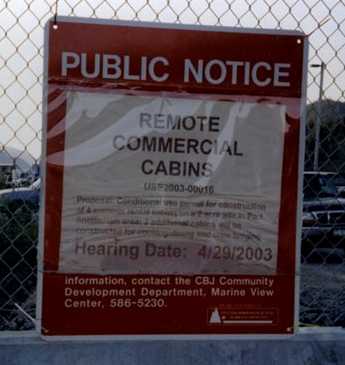
City to procure a building permit and conditional use permit (see photo
below of the public notice sign posted at Douglas Boat Harbor), hired
another engineer to design water treatment systems, looked for tour
boats, hired a lawyer to put together a lease for the land,
incorporated as an LLC, bought a business license, wrote a business
plan, and so on.
The winter of 2002-2003
began serious plans for the business and my
life was more hectic and stressful than anything I'd ever like to put
myself through again. I spent every 15
minute break at work, every lunch hour and most of my free time
researching everything I could think of to buy, build, or create. Cabins, floor plans, incorporation/licensing,
land lease, furniture, propane appliances, drinking water systems,
waste water systems, permitting, boats, etc.
By the spring I was running myself to exhaustion trying to put
everything together. I found cabin kits in
British Columbia, hired an engineer to design a lodge, worked with the
City to procure a building permit and conditional use permit (see photo
below of the public notice sign posted at Douglas Boat Harbor), hired
another engineer to design water treatment systems, looked for tour
boats, hired a lawyer to put together a lease for the land,
incorporated as an LLC, bought a business license, wrote a business
plan, and so on.
 It doesn't sound nearly as onerous written
out that way as when I was doing it; every step was a trial. I went through serious negotiations with the
City for several months about the first cabin kits I located, but in
the end they turned out to be too small to be considered habitable. I considered platforms and wall tents, but
nixed the idea. The next set of cabins I
found were more substantial, but required review by an engineer. In order to release the plans, British Columbia
manufacturer StarTek required a $1,000 down payment which theywere
reluctant to return in the event that the engineer wouldn't approve
them. We worked that out and with some
modifications an engineer signed off on the plans and I ordered four
kits after weeks of back and forth on the specifics of the building. The kits are designed without a floor so the
same engineer designed a foundation/floor system out of pressure
treated lumber.
It doesn't sound nearly as onerous written
out that way as when I was doing it; every step was a trial. I went through serious negotiations with the
City for several months about the first cabin kits I located, but in
the end they turned out to be too small to be considered habitable. I considered platforms and wall tents, but
nixed the idea. The next set of cabins I
found were more substantial, but required review by an engineer. In order to release the plans, British Columbia
manufacturer StarTek required a $1,000 down payment which theywere
reluctant to return in the event that the engineer wouldn't approve
them. We worked that out and with some
modifications an engineer signed off on the plans and I ordered four
kits after weeks of back and forth on the specifics of the building. The kits are designed without a floor so the
same engineer designed a foundation/floor system out of pressure
treated lumber.
Then I tried to send money to Canada to purchase the kits,
which proved surprisingly difficult. My
bank wouldn't do it, nor would the money sending businesses in town. I eventually gave up and agreed to FedEx a
cashier's check from Key Bank.
Unfortunately, the receiving bank in Canada wouldn't accept the
check because they believed it was a personal check rather than one
issued by the bank (which I found quite baffling, since the check
included the statement "Official Check" at the top). Luckily I was able to hire a landing craft to
coordinate with the shipment and deliver to the homestead.
I wanted to send down everything I needed for all my buildings at once,
so I scrambled to order all the building materials for the lodge I'd
planned (I paid the engineer who designed the building a little extra
to put together a materials list), as well the materials for the
foundations on the cabin kits. Valley
Lumber put together most of the items, though I had to go to Don Abel
for matching windows. I also scurried
around town from one plumbing store to the next trying to procure
enough black pipe for the water system. These shenanigans (the
first of a series of frustrations with StarTek) caused serious delays
so that the cabins did not arrive until the end of June.
On top of all this I took two evening classes spring semester
from the University of Alaska Southeast to better prepare myself for my
business--Diesel Engine Repair and Basic Construction
Techniques. I excelled at neither, but
the construction class gave me the background to design and build my
own outhouses and a core of knowledge that has proved invaluable since. Though I grew up in the wilderness, I had
steadfastly avoided learning about tools, boating, cutting trees,
plumbing, and all the other sundry homesteader tasks that my parents
had mastered. It all seemed too daunting as
a kid, so much knowledge and experience that I didn't think I'd ever be
able to absorb it. The idea that I was
incompetent--dependent on other people for any complicated
task--haunted me for years. This project,
however, compelled me to learn dozens of new scary skills and forced me
to confront my ignorance and admit it to those who could help. It's been a tremendous lesson in humility and a
great confidence builder.
 When classes were over I got busy
after work and on the weekends preconstructing foundation feet for the
cabins and designing and building outhouses for assembly on site, all
of which were meant to go on the landing craft.
The foundation feet the engineer designed to support all the buildings
are constructed of lumber. I wanted to
prefabricate as many as I could in Juneau to ease construction on site
so I bought a bunch of pressure treated lumber and bolts, borrowed my
parents' huge drill to make the bolt holes, and overcame my deep terror
of chain saws to cut the lumber in my driveway.
Though manlier people make fun of me for it, my little green Poulan
chain saw from Fred Meyer's is one of my most prized wilderness
possessions. My engineer developed the
foundation design with lumber because I dreaded the idea of hauling
down and mixing concrete in a completely undeveloped land and digging
holes three feet deep or more (the required depth to prevent frost
upheaval). The feet are made with two 2X12
boards sixteen inches long side by side (the foot) crossed and bolted
together with a 4X6. Rising upright from
this is a 6X6 post attached with a bracket.
I made enough for the first two cabins.
When classes were over I got busy
after work and on the weekends preconstructing foundation feet for the
cabins and designing and building outhouses for assembly on site, all
of which were meant to go on the landing craft.
The foundation feet the engineer designed to support all the buildings
are constructed of lumber. I wanted to
prefabricate as many as I could in Juneau to ease construction on site
so I bought a bunch of pressure treated lumber and bolts, borrowed my
parents' huge drill to make the bolt holes, and overcame my deep terror
of chain saws to cut the lumber in my driveway.
Though manlier people make fun of me for it, my little green Poulan
chain saw from Fred Meyer's is one of my most prized wilderness
possessions. My engineer developed the
foundation design with lumber because I dreaded the idea of hauling
down and mixing concrete in a completely undeveloped land and digging
holes three feet deep or more (the required depth to prevent frost
upheaval). The feet are made with two 2X12
boards sixteen inches long side by side (the foot) crossed and bolted
together with a 4X6. Rising upright from
this is a 6X6 post attached with a bracket.
I made enough for the first two cabins.
The foundation feet were frustrating, but ultimately
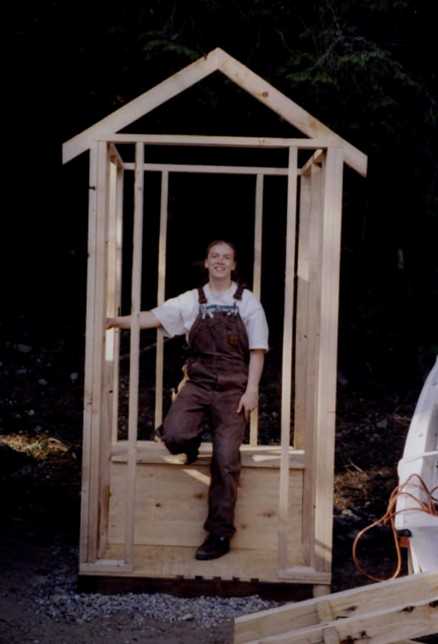
satisfying; the outhouses, however, are my pride and joy (see photo). I began constructing them one wall at a time on
the garage floor, moving them outside to fit them all together. A great deal of thought went into their design,
with their pressure treated foundation, the perfect toilet seat height,
and the gable roof. I built doors out of
1X6 pine boards, joining them with the classic "Z" on the inside, and
heavily staining them with a pale stain. I picked out attractive,
rustic hinges and bought Navajo red paint for the exterior walls and
clear corrugated roofing to let in light.
After assembling both, they were partially dismantled for transport.
As an aside, I had a series of somewhat amusing experiences in
hardware stores during this phase due to my gender, coupled perhaps
with my age and evident ignorance. I went
to Western Auto in the spring to pick up a cordless drill for outhouse
construction and when I checked out, the fellow at the counter smiled
kindly and said, "Father's Day present, eh?"
I was momentarily confused. At Valley
Lumber when I bought 4X4 PT (pressure treated) and 2X4 regular lumber
for the outhouse, the guy at the checkout counter asked politely if I
was building flower boxes. At Good Hardware
I came in for a pickax and a tape for digging foundation holes and a
helpful employee asked if I was looking for gardening equipment. I learned to find this all amusing rather than
offensive.
In May I made my way down and began to get a feel for the
land, digging a few test holes to see how the foundation work would go. Here's a tidbit that describes my reaction:
5/16/03
What a marvelous place. I am at Snettisham
camped on Otter Point [the rocky point] and my fingers are starting to
warm up after brushing my teeth...I was greeted at the greening beach
by a big vibrant golden plover which I soon discovered was surrounded
by eight or so small gray mottled shorebirds.
A pair of [teal] has been around the place all afternoon.
I watched the pair at low tide snooting around in the mud...
So I was shocked to find that the water around here is quite shallow! At the base of the rocky point the mud began to
show around 5:00 as I was lighting a
fire for dinner (beach grass and dry sticks).
By 6:30 I could almost walk across
the inlet. I could go straight out perhaps
.5 mile or so, and I walked at least a mile and a half upriver until I
finally was met by the river cutting against the bank.
Marvelous! A regular, dramatic SE AK
shoreline with steep rocks, towering spruces, crags, Stika alders, but
with a flat, sandy beach at the foot to peruse it!
I never would have guessed. Fry and larvae
in the back eddies and "tidepools," American pipits, varied thrush,
Wilson's warbler, Townsend's, hermit thrushes singing, gulls on the
sandbars and circling, bald eagles. Back at
the homestead Barrow's goldeneyes, buffleheads, Arctic terns diving
just offshore and a dozen harbor seals slapping and diving and maybe
resting on submerged sandbars across the river.
The Start of Construction
A few weeks before the landing craft trip was scheduled, my parents
took their boat down with a load of foundation feet to start the first
cabin floor. When faced with the plan and a
shovel, I was at a complete loss.
Thankfully, my parents were not. Under my
dad's guidance, my parents and I dug eight foundation holes, placed my
pre-constructed foundation feet inside, and slowly worked our way
toward a foundation (see photo--Mom, Dad, Rosie at the first hole). I had cut 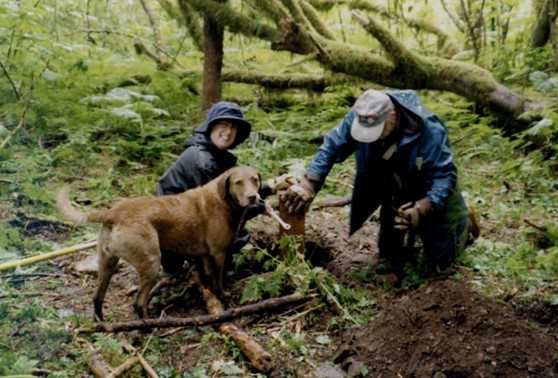 the 6X6 upright posts three
feet long figuring that this was ample height.
Unfortunately, the land on site was not flat, and we discovered that
several of my pre-cut posts were simply too short to make up the
difference between the downhill holes and the uphill holes without
digging the uphill holes impossibly deep or the lower ones too shallow. We excavated as much dirt as we thought prudent
but ended up leaving the site in frustration, having no tools to cut
additional posts. We pulled anchor and grumpily sailed north, the first
of many such frustrations and delays.
the 6X6 upright posts three
feet long figuring that this was ample height.
Unfortunately, the land on site was not flat, and we discovered that
several of my pre-cut posts were simply too short to make up the
difference between the downhill holes and the uphill holes without
digging the uphill holes impossibly deep or the lower ones too shallow. We excavated as much dirt as we thought prudent
but ended up leaving the site in frustration, having no tools to cut
additional posts. We pulled anchor and grumpily sailed north, the first
of many such frustrations and delays.
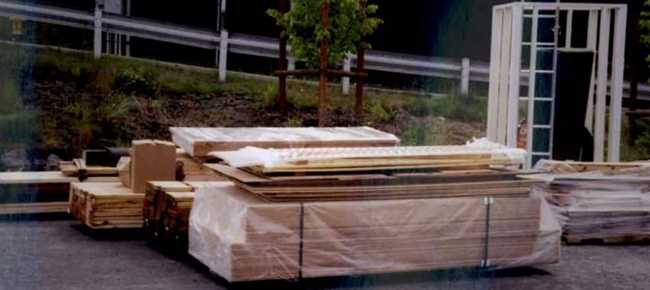
Landing Craft
The day finally came for the landing craft, and all miraculously went
smoothly. I rented a U-Haul to carry the
outhouses, foundation feet, and miscellaneous lumber to Auke Bay;
Alaska Marine Lines, Don Abel and Valley Lumber delivered the rest. My mother, Larry and I spent less than two
hours on site while captain Paul loaded his landing craft the Lightweight. Hardly an apt
name, the barge was huge, and my load took up only a minor portion of
the bow.
While the Lightweight was underway, the three
of us flew to the property and spent a few hours with clippers and a
chain saw clearing the brush from in front of the lodge site/storage
area. This area became known as "Home
Depot" during the construction phase. Of
course, to enter the forest, one first has to traverse the marshy beach. Marsh marigolds, shooting stars, and wild
irises bloom there in the spring, testimony to the wetness of the
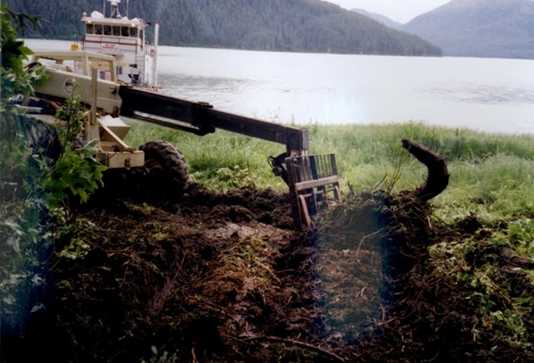
ground. The Lightweight's forklift delved
deep ruts in the black mud which grew deeper and more treacherous with
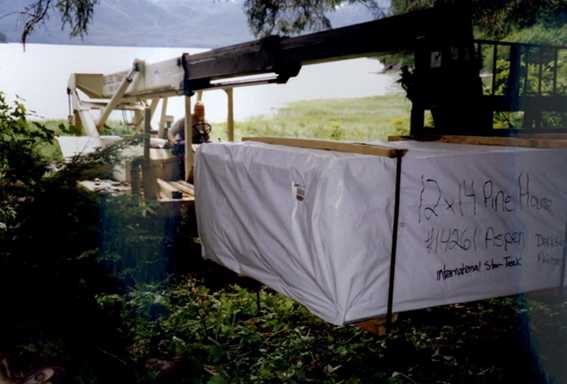
each load. First the outhouses came off,
then the lumber and building kits, all tidily bundled on pallets. The muddy forklift struggled and spun in the
muck, overheating the engine as Paul made trip after trip between the
shore and the treeline (see photos below).
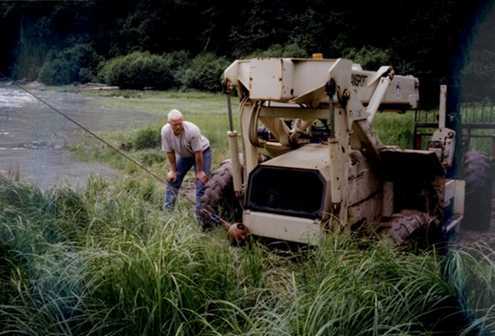
When the final load was at last delivered and the forklift was making
its way back to the barge, a back wheel sank into a deep natural hole
and spun. No amount of effort would draw it
out (see photo below). I watched as Paul
struggled with the machine, committing myself to the inevitability of
replacing it should he fail. His wife moved
the barge closer and they attached a winch to the forklift and
eventually pulled it out, much to my relief.
Larry rode the barge back home and my mother and I camped on
the point for the night. That afternoon, as
we laboriously hoed at the deep ruts worn in the soggy ground in a
futile effort to fill them back in, I looked up to see two orcas
crossing the inlet from Gilbert Bay, a large male and smaller one. I also strained my back in the effort, causing
chronic pain down my right leg ever since.
But at least all my building supplies were on site.
Construction Again
A few weeks later I managed to get back down there, with longer posts
in tow. First I began work on digging holes
for the second cabin and did a variety of other odd projects. The second cabin site was bordered on one side
by a stand of closely grouped, second growth-type trees that suggested
to me that the saltery may have had a building there; judging by the
many artifacts I found (including colored glass, ornamental pieces of
metal, tools, etc.) I began to wonder if it
was a midden.
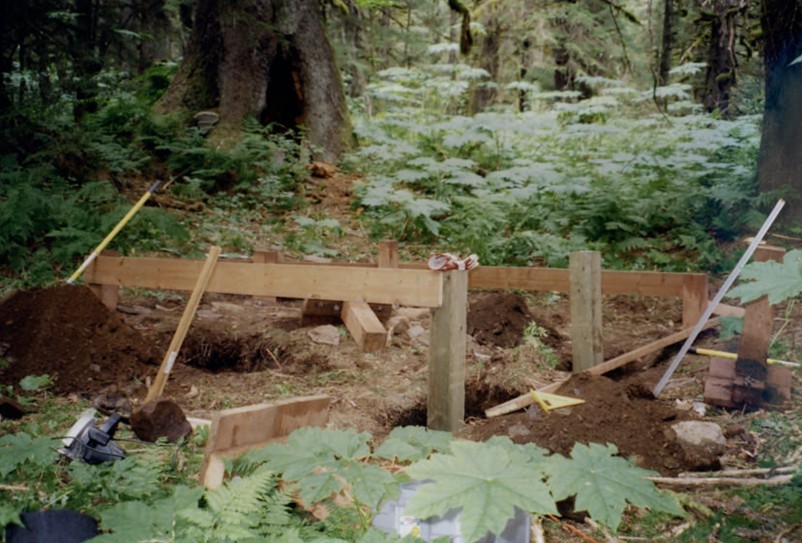
Once my folks showed up we started back at the first
foundation and I remember clearly my utter bewilderment as my father
demonstrated how to arrange the posts and square the building while
keeping the correct dimensions. Once the
foundation feet were in and the posts ready we had to cut notches in
them to fit in the rim joists (the boards that form a box around the
outside of the posts). Still a little
unsteady with the chainsaw, my dad was good enough to cut them for me. We attached the rim joists, then hung the floor
joists, again having to excavate dirt on the uphill side (see photo
below). The next morning I learned how to
glue and nail the floor, my mother and I proud of ourselves when we
didn't miss the joists as we nailed (see photo below).
 Once the
floor was in place, we thought we'd begin the real fun--putting up the
cabin itself. No such luck.
The bottom "board" of the walls is a 2X2 cedar strip in eight pieces,
four short and four long that are meant to fit together in a rectangle. We spent some time in various combinations of
pieces, but none of them fit the floor we'd just built.
We repeatedly consulted the instructions that StarTek had sent. Then we consulted the plans that had come with
the kits themselves, which were alarmingly different. After
much trial and error, reading and rereading the instructions, we
finally came to the conclusion that the building was several inches
longer and wider than it was supposed to be; the floor, laboriously
built, was simply too small. I had
checked and rechecked with my contact at StarTek as to the dimensions
of the building specifically to make sure that the foundation I built
was the correct size. He had been wrong. My father finally solved the problem by simply
nailing two extra pieces of pressure treated 2X8s to the outside of one
of the rim joists. Unattractive and
unprofessional, but functional.
Once the
floor was in place, we thought we'd begin the real fun--putting up the
cabin itself. No such luck.
The bottom "board" of the walls is a 2X2 cedar strip in eight pieces,
four short and four long that are meant to fit together in a rectangle. We spent some time in various combinations of
pieces, but none of them fit the floor we'd just built.
We repeatedly consulted the instructions that StarTek had sent. Then we consulted the plans that had come with
the kits themselves, which were alarmingly different. After
much trial and error, reading and rereading the instructions, we
finally came to the conclusion that the building was several inches
longer and wider than it was supposed to be; the floor, laboriously
built, was simply too small. I had
checked and rechecked with my contact at StarTek as to the dimensions
of the building specifically to make sure that the foundation I built
was the correct size. He had been wrong. My father finally solved the problem by simply
nailing two extra pieces of pressure treated 2X8s to the outside of one
of the rim joists. Unattractive and
unprofessional, but functional.
Then we started the Lincoln-log type assembly of the walls,
which was mostly fun in the beginning. We
added the tongue and groove "logs" (2X6s) in a circle around the
building. The rain had started in earnest
during the afternoon so we spanned the walls with a ladder and covered
the building with a blue tarp for the night (see photo below). My folks returned to their boat for the night
and I returned to my tent, pitched in the driest spot on the property
where the dry campfire would later reside near the point.
At eight in the morning I wandered down to the beach to meet
my folks for breakfast, but discovered not only no tender to bring me
over, but no boat in sight. I had a moment
of panic imagining that my parents had left me there but quickly
decided they must have gone sightseeing early.
I was hungry and a little grumpy, but within an hour they steamed back
into sight. Apparently the anchor had drug
in the night and they woke up around the corner in sight of Stephen's
Passage. The edge of the sandbars drops off
precipitously into deep water and the falling tide had sloughed the
anchor off the bottom and set the boat adrift.
The rain continued steadily and soon everything was covered in
mud, the walls slick with water, muddy dog prints covering the floor
(see photo below). It was sloppy work and
we ran into another major obstacle before we finished the walls; we
were one log short (or, rather, one of the logs was the wrong length). Thankfully, we had three (theoretically)
complete kits to dig into. I broke into the
next kit on the stack and laboriously measured accessible logs until I
found one that matched the required piece.
Once this problem was tackled and the walls were up, we were faced with
another deficiency. In order to support the
walls, eight "redi-rods" (pieces of rebar) were included with the kit
and the logs had holes cut through them to allow the rods to slide from
ceiling to floor. Bolts on the top and
bottom were meant to be tightened to hold the walls together.
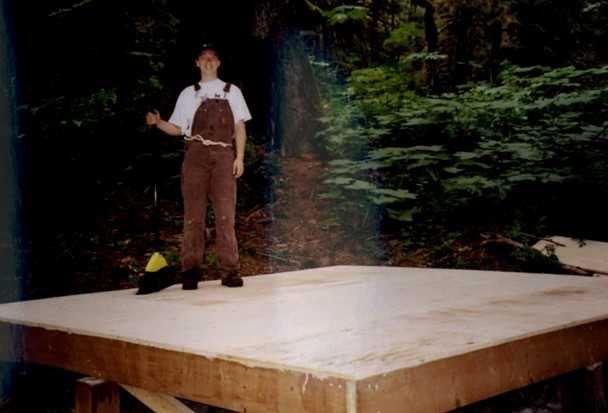 Unfortunately, half the bolts
weren't included so we placed the rods in the walls with the bolts on
top with the intent to come back later and add the bolts to the bottom
and tighten them.
Unfortunately, half the bolts
weren't included so we placed the rods in the walls with the bolts on
top with the intent to come back later and add the bolts to the bottom
and tighten them.
All in all the learning curve was steep. The damp logs took a
great deal effort to whack into place, but we persevered.
By the end of the day the walls and gables were up, but we were
forced to return a few weeks later to put the wooden roof panels
on. Unfortunately, we weren't able to install the metal roofing
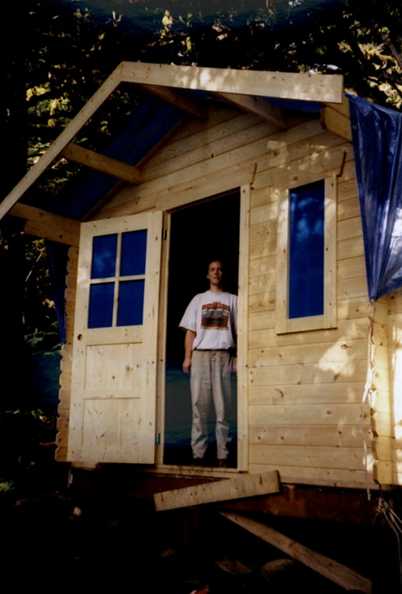
so we left it with a tarp over the top until we could return. Despite the frustrations and the weather, the
cabin was adorable and the inside (other than the muddy floor) was
stunning pale pine boards and cute windows (see photo at bottom).
Here's a journal entry describing the weekend, which gives a
flavor of my mood:
8/6/03
The weather did cooperate or a few days, but I worked so much that
there was no time or energy for catharsis.
I got much work done, digging the four corners of the second cabin and
nearly squaring it, (finding treasures all the way including a 5'
crosscut saw, more metal pieces, and a perfectly intact sarsaparilla
bottle dead center under the moss of my last hole).
The first thing I'd done was clear a wide trail connecting the first
cabin site with the stockpile. I was rather
proud of it and my heroic use of the chain saw to accomplish it. I also moved most of the stack of lumber in the
bushes in order to give it more support and unearth the 2X8s for the
floor. The first frustration was
discovering that Valley Lumber had failed to include any of the
supplies to finish the little cabins.
I also dug a two foot hole to get started for the
first outhouse and, on Saturday morning, started the generator and
assembled more foundation posts. Things
went downhill when my folks arrived in the afternoon.
The weather turned to rain and by that time I'd done so
much cutting, hauling, chopping, digging, hoeing, and grasping that my
right arm was injured and swollen and remained gimpy the rest of the
trip. We cut the 2X8s and fitted them
fairly easily into the brackets [for the floor joists], we cut all but
one piece of plywood before dinner, and I learned my lesson about not
using the archaic 19.2" on center because you have to cut every piece
of plywood to get it to rest on a joist!
Next morning before the rain started we glued and nailed the floor on
and I started sifting through the first cabin kit while Mom and Dad had
breakfast. Beautiful wood.
As we started assembling the floor the real
problems began. It was hard enough to follow three conflicting sets of
instructions but then we set up the bottom logs to find that it was too
big by 2.25" in width and 2.5" in length!
They screwed up! And [my StarTek contact],
when I told him last week, had the nerve to suggest that, after all,
they did urge me to buy their floor system!
I explained how that would not have helped and haven't heard back. Anyway, we spent a good time wasted while
searching for PT 2X8s and scabbing two on the right and
back sides. Then screwed together the cedar
strips [bottom logs] before dinner. We got
about four layers [of logs up the walls] and the door dropped in before
quitting for the night. I stayed, added a
few more, supported the door and threw a tarp over the whole thing for
the rain.
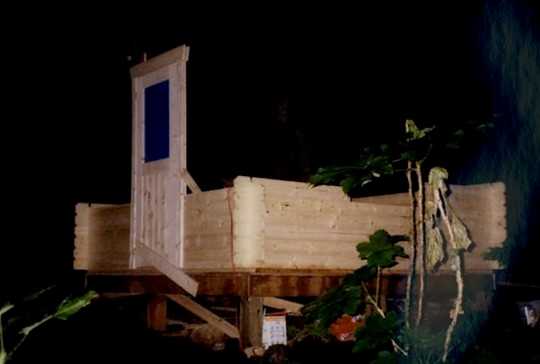
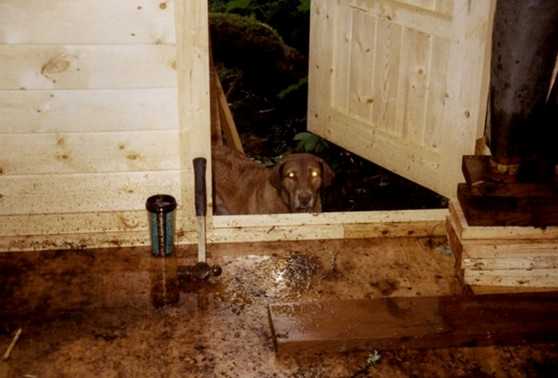
Next morning it poured and
never quit all day until we pulled anchor. It was miserable
work. My arm ached, I could hardly pound, we were soaked, mud was
splattering onto the walls on the inside, the new floor was warped and
squishing, the pieces around the windows hard to get in--and I smashed
my thumb. The last problem was that the two bottom side pieces
were 138" and 144" and, well, clearly didn't fit together [they should
have been the same length]! We put a plain 144" piece in and
stole one from another kit to make up for it. By two we got all
the walls up to the gable. Pretty cute, really, but I walked away
disheartened, discouraged, and thoroughly unready to return to work
next day.
Setback
Then I nearly died. After the chaotic and
stressful spring and early summer, I was beyond exhaustion and
constantly pushed to the end of my rope. On
top of long hours and tons of errands, everything I did was out of my
realm of expertise, or even basic knowledge.
By the time August rolled around, I was thoroughly ready for a
long-awaited dive vacation to the Bahamas. This in itself was very stressful as Larry and
I had chartered the boat and found it uncomfortably difficult to fill
all the rooms and recover costs. On the
fifth day of the charter I came down with bacterial meningitis and
wound up unconscious in the hospital on the brink of death. There is no explanation for why I came down
with meningitis (it was not dive-related) but I am convinced that my
state of stress and exhaustion was the primary cause.
Two weeks later I made my way home, too weak to walk more than 50 feet
by myself and still a month away from returning to my desk job. Needless to say, this badly curtailed further
construction that season. In early October,
when I was still weak, my folks and I returned and installed the metal
roof on a cool, sunny day and buttoned the place up for the winter.
 Cottonwood Cabin and the tree shed