 Allow me to describe the setting (see the
map for its geographic relation to
Juneau). The land, occupied by J. T. Martin
in 1882 fo a fish saltery, is nearly two acres in size and forms a
rough rectangle along the water (see the site/grading plan on the original
plat for details). It sits about a quarter
mile inside the Whiting River Inlet off of Gilbert Bay on the only
flattish non-marshy land in the area. Based
on its location and the rocks in the ground my guess is that it is the
remnants of an old rock/landslide--the mountains to either side rise
more or less straight up from the water.
The gradual slope of the homestead is broken by numerous flat spots,
but behind the private property boundary the land rises steeply. It is the only private land for miles, and
certainly the only private land in sight, and about 35 miles from the
nearest road system in Juneau. When I began work the land was
completely undeveloped, so much so that I wonder if the saltery removed
the buildings and all equipment when they left.
Allow me to describe the setting (see the
map for its geographic relation to
Juneau). The land, occupied by J. T. Martin
in 1882 fo a fish saltery, is nearly two acres in size and forms a
rough rectangle along the water (see the site/grading plan on the original
plat for details). It sits about a quarter
mile inside the Whiting River Inlet off of Gilbert Bay on the only
flattish non-marshy land in the area. Based
on its location and the rocks in the ground my guess is that it is the
remnants of an old rock/landslide--the mountains to either side rise
more or less straight up from the water.
The gradual slope of the homestead is broken by numerous flat spots,
but behind the private property boundary the land rises steeply. It is the only private land for miles, and
certainly the only private land in sight, and about 35 miles from the
nearest road system in Juneau. When I began work the land was
completely undeveloped, so much so that I wonder if the saltery removed
the buildings and all equipment when they left.
 Given the surrounding landscape,
it's not surprising that Martin chose this piece of land to homestead. At the time, the water in front must have been
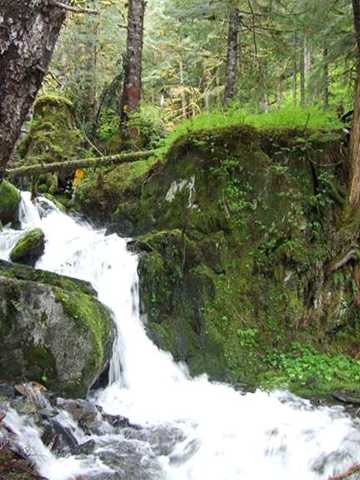
deep, allowing barges and fishing boats to access the shore. A rushing creek courses down the mountain
behind (see photo to left), its mouth forming the northeast corner of
the property. The southeast corner is at
the tip of a beautiful rocky point that protrudes into the river, rife
with wildflowers and lichens (see photo to right).
At the top of these rocks is a mossy mound where eagles and probably
other critters enjoy their meals of crab and fish, looking over a
commanding view of the river. The land has
been stable for some time, evidenced by the mature old growth forest
covering the property. Huge spruces
dominate the canopy and the forest floor is thick with mosses, ferns,
blueberries and devil's club (see photo below).
Given the surrounding landscape,
it's not surprising that Martin chose this piece of land to homestead. At the time, the water in front must have been
deep, allowing barges and fishing boats to access the shore. A rushing creek courses down the mountain
behind (see photo to left), its mouth forming the northeast corner of
the property. The southeast corner is at
the tip of a beautiful rocky point that protrudes into the river, rife
with wildflowers and lichens (see photo to right).
At the top of these rocks is a mossy mound where eagles and probably
other critters enjoy their meals of crab and fish, looking over a
commanding view of the river. The land has
been stable for some time, evidenced by the mature old growth forest
covering the property. Huge spruces
dominate the canopy and the forest floor is thick with mosses, ferns,
blueberries and devil's club (see photo below).
The beach, admittedly, leaves something to be desired.
The Whiting River is a glacial river and the silt it carries is slowly
filling in the inlet. At high tide, the
water looks deep off the property and the shoreline is a beautiful
dramatic rocky landscape overhung with trees. Low tide, on the
other hand, reveals a flat terrain of sandbars.
At a -4' tide (as low as it gets) there is only one narrow rushing
channel of water on the far side of the valley and one can walk out
onto the sand and silt everywhere. It helps
with claustrophobia if you feel hemmed in by the steep mountains and
thick forest. The sandbars drop off two or
three hundred yards downriver from the homestead in a precipitous slope
to deeper waters. The beach close to shore
has a gradual grade until it hits the flatness of the sandbars, mostly
covered in slick shale and seaweed (see photo below left).
This makes loading supplies and transportation a little tricky and
often unpleasant, especially at low tide. Between the high tide
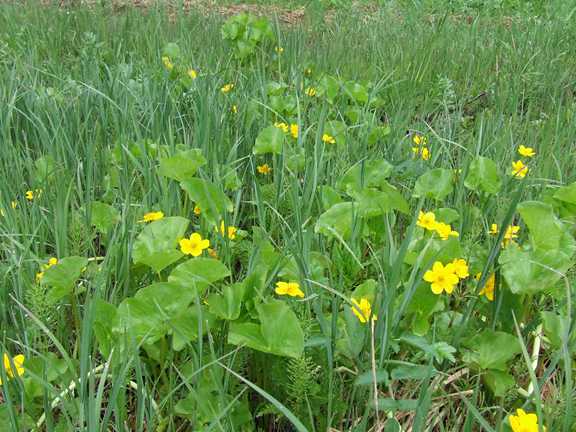
line and the forest is a marshy area of grasses, marsh marigolds (see
photo below and bottom left), shooting stars, irises and other plants
that favor soggy ground.
Natural spacings between the trees suitable for small cabins are
abundant, but there was really only one place on the property
acceptable for a lodge. This was at the
southeast corner of the homestead—a space devoid even of baby trees and
perfectly sized for my lodge. The porch of
the lodge looks out over the inlet toward a stunning view of Gilbert
Bay. Just upriver from the lodge building
(toward the creek and the rocky point) is a wet, almost springlike area
thick with alders and elderberries and always muddy.
On the other side of this area the cabins begin, numbered according to
the order in which they were built (and proximity to the lodge) and
later named Cottonwood (aka Carp's Cabin), Mink, Harbor Seal, and
Hermit Thrush. The second photo below is the view from
Cottonwood Cabin looking downriver toward Gilbert Bay.



The Wildlife
One of the great joys of spending time in Snettisham is, of course,
watching wildlife--abundant and not particularly habituated to fear
humanity. One of the first exciting
encounters I had was with a mink and, though their population seems to
fluctuate, the area appears to be good mink habitat (see photo below). Mink Cabin is named for one dark mink who
used to romp by every day while I worked on it in 2004.
River otters also frequent the area, though I see only tracks of them
at often as I see them in the water or loping along the land. Several beaver have passed by, hopefully bound
for better habitat upriver. The river
itself is alive with harbor seals who show endless curiosity in our
activities whether we're on the beach or on the water (see photo below). Though their abundance varies during the season
and the tides, there is always at least one keeping an eye out on
anyone within sight. The seals of
Snettisham are very active, frequently slapping the water with their
hind flippers. They also breach, a behavior
I'd never associated with harbor seals. I
once watched one individual breach like a whale a dozen times or more
in a row, seemingly without taking enough time between breaches to feed
(the only explanation I could think of for this odd behavior other than
play or social interaction). Sea lions are
around in the early spring when the nearby winter haul-out is active
(through May) and again in the fall, but they don't make an appearance
for most of the summer (see photo below).
To round out the marine mammals, there are of course whales! Humpbacks frequent not just Port Snettisham,
but the river inlet itself where they come right to the edge of the
sandbars to feed (see photo below). Their
numbers vary, but it appears that feeding there is frequent, and they
are very likely to be in the general area (if around the corner from
the homestead) all summer long. There
appears to be something interesting going on in the area in terms of
food sources for marine critters. The
marbled murrelet, a diminutive sea bird that gains notoriety for
nesting in trees up to 50 miles from water, is found in Port Snettisham
in larger numbers than anywhere else biologists have studied it. Stephen's Passage, the large body of water
outside the port, is more or less devoid of whales during the middle
months of summer, and yet a few miles inside Snettisham they feed all
season. The two animals share similar
diets, so I figure something is drawing them in.
As for orcas, I've seen them from the homestead once, so I am hopeful.


Land mammals aren't quite as abundant, but we do see a few. A little shrew kept me entertained for a few
days rooting for grubs in front of the lodge, not to mention the deer
mice that colonized the building in 2006.
Red squirrels are abundant and porcupines visit.
About 20 feet from the back of the lodge is one end of a bear trail,
the paw prints sunk at regular intervals into the moss on the forest
floor. In 2005 I found a black bear bed
between the roots of a spruce tree in the same area.
Black and brown bears are around (see photo above) and I've seen both
from the homestead, but rarely on it (though they leave abundant
evidence of their passing). Bats live in
the area, too.
The bird life is exciting. Spring
migration fills Port Snettisham with hundreds of murrelets, murres,
loons, cormorants, scoters and other marine birds, some of which stay
all summer. Plovers and other shorebirds
stop on the grassy shores of the homestead in the spring as do
mergansers, teal, and other ducks. Arctic
terns and Bonaparte's gulls move up and down the river with the tide,
following the edge of the sandbars. The
woods are home to thrushes, chickadees, warblers, jays, kinglets,
wrens, dippers, and hummingbirds. The sound
of a single flycatcher calling in the branches while I work in the
forest on hot sunny days is to me quintessential Snettisham. I've seen and heard goshawks (I have a sneaking
suspicion they nest in the area) as well as northern harrier hawks. Eagles nest on the homestead and all along the
surrounding shores (see photo above).
What about amphibians? Western toads
are about all I can offer there, which I've seen on several occasions
in the forest and on the marshy beach. The
five major species of Pacific salmon run up the river, as do steelhead
and eulachon (I think). We once found a
live starry flounder stranded in the sand at low tide and the tidepools
are inhabited by tiny sculpins. Fry
frequent the shallows at high tide. Once at low tide the beach
was covered in thousands of dead spot prawns and the surrounding area
is good for shrimping generally. Around the corner in Gilbert Bay is
the mouth of Sweetheart Creek where hatchery released sockeye and pink
salmon return mid-summer to pack the creek (trip reports on fishing
Sweetheart Creek are posted among the 2006
trip reports). Upriver the Whiting turns into a classic
Southeast Alaska glacial fed river with clear water tributaries feeding
into it and grassy meadows and cottonwoods along the borders. Due to
the shallow water, I have yet to explore beyond the first few turns
(see photo bottom right of the view upriver from Ox Point) but I can't
wait.


Back to top
